The genus Arachnis, abbreviated as Arach in horticultural trade, (common name scorpion orchid,) is a member of the orchid family (Orchidaceae), consisting of more than 20 species native to China, India, Southeast Asia, Indonesia, the Philippines, New Guinea, and the Solomon Islands.
Description
Vegetative characteristics
The appearance of the monopodial, epiphytic herbs of the genus Arachnis is characterized by distichously arranged, linear leaves. The vining plants may grow into a dense thicket. Arachnis does not produce pseudobulbs.
Generative characteristics
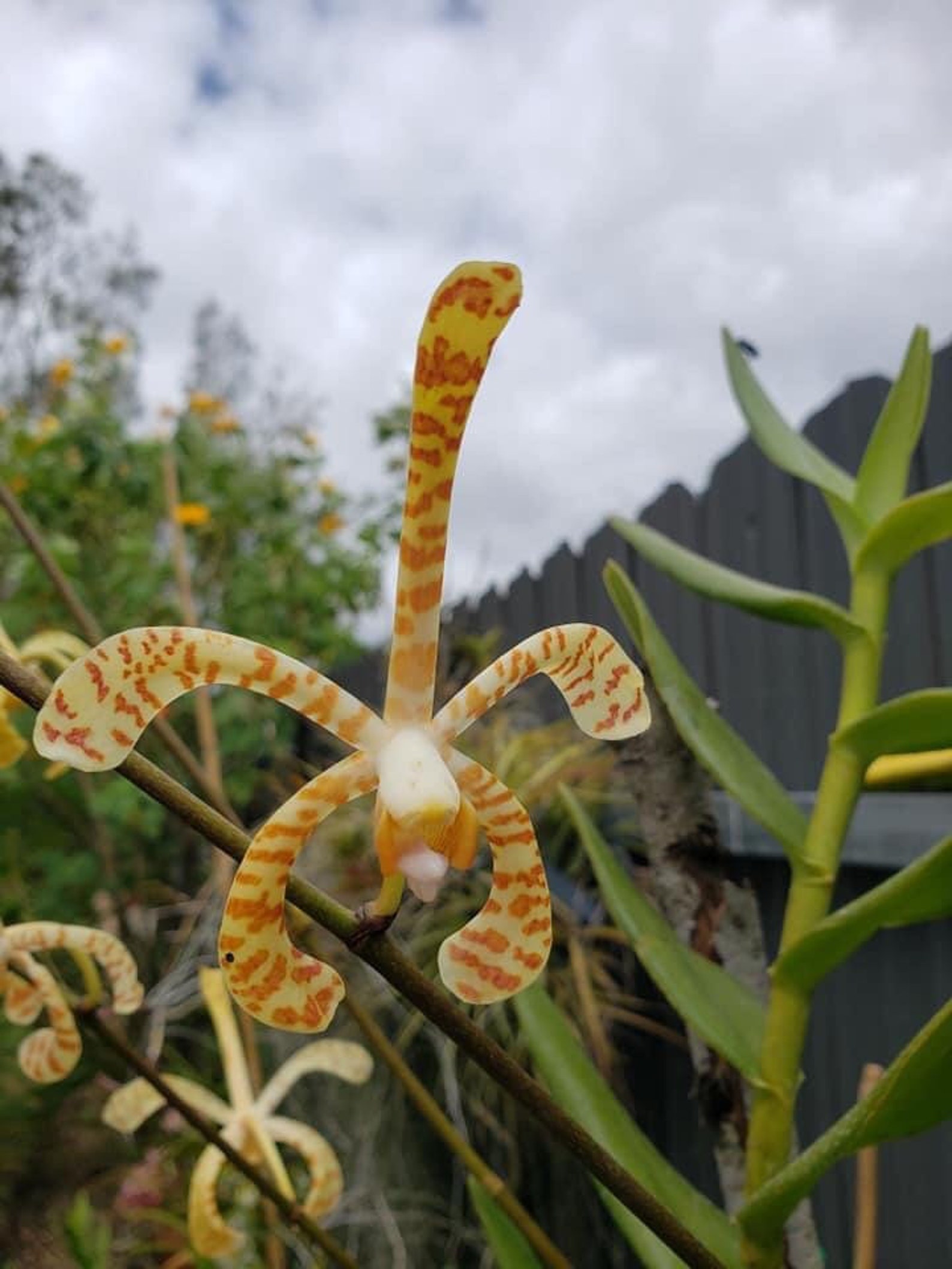
The flowers are thought to resemble spiders, and they are fragrant. The fragrance has been described as musky.
Etymology
The generic epithet Arachnis is derived from the Greek word arachne for spider.
Ecology
Habitat
Arachnis senapatiana has been found growing in subtropical broad-leaved forests at elevations of 1747 m above sea level.
Flowering
Arachnis senapatiana is known to flower in June.
Taxonomy
Accepted species
There are currently 16 accepted species, including one natural hybrid:
- Arachnis annamensis (Rolfe) J.J.Sm.
- Arachnis bella (Rchb.f.) J.J.Sm.
- Arachnis bouffordii Ormerod
- Arachnis calcarata Holttum
- Arachnis cathcartii (Lindl.) J.J.Sm.
- Arachnis clarkei (Rchb.f.) J.J.Sm.
- Arachnis flos-aeris (L.) Rchb.f.
- Arachnis grandisepala J.J.Wood
- Arachnis hookeriana (Rchb.f.) Rchb.f.
- Arachnis labrosa (Lindl. & Paxton) Rchb.f.
- Arachnis limax Seidenf.
- Arachnis longisepala (J.J.Wood) Shim & A.Lamb
- Arachnis × maingayi (Hook.f.) Schltr.
- Arachnis senapatiana (Phukan & A.A.Mao) Kocyan & Schuit.
- Arachnis seramensis (Ormerod) R.Rice
- Arachnis siamensis (Schltr.) Tang & F.T.Wang
- Arachnis sulingi (Blume) Rchb.f.
Species formerly placed in Arachnis
- Arachnis beccarii Rchb.f. is now considered to be Dimorphorchis beccarii (Rchb.f.) Kocyan & Schuit.
- Arachnis breviscapa (J.J.Sm.) J.J.Sm. is now considered to be Dimorphorchis breviscapa (J.J.Sm.) Kocyan & Schuit.
- Arachnis celebica (Schltr.) J.J.Sm. is now considered to be Dimorphorchis celebica (Schltr.) Ormerod
- Arachnis imthurnii (Rolfe) L.O.Williams is now considered to be Dimorphorchis beccarii var. imthurnii (Rolfe) Kocyan & Schuit.
- Arachnis longicaulis (Schltr.) L.O.Williams is now considered to be Dimorphorchis breviscapa (J.J.Sm.) Kocyan & Schuit.
- Arachnis lowii (Lindl.) Rchb.f. is now considered to be Dimorphorchis lowii (Lindl.) Rolfe
- Arachnis lyonii Ames is now considered to be Dimorphorchis lyonii (Ames) Ormerod
- Arachnis muelleri (Kraenzl.) J.J.Sm. is now considered to be Dimorphorchis beccarii var. beccarii
- Arachnis philippinensis (Lindl.) Ames is now considered to be Trichoglottis philippinensis Lindl.
- Arachnis rohaniana (Rchb.f.) Rchb.f. is now considered to be Dimorphorchis rohaniana (Rchb.f.) P.J.Cribb
- Arachnis beccarii var. imthurnii (Rolfe) K.W.Tan is now considered to be Dimorphorchis beccarii var. imthurnii (Rolfe) Kocyan & Schuit.
- Arachnis longicaulis f. flavescens Valmayor & D.Tiu is now considered to be Dimorphorchis breviscapa (J.J.Sm.) Kocyan & Schuit.
Conservation
Arachnis has become extinct in Nansei-shoto.
Horticulture
It can be cultivated under warm and moist conditions growing in pots, baskets, or mounted on slabs.
References
External links
- Media related to Arachnis (Orchidaceae) at Wikimedia Commons
- Data related to Arachnis at Wikispecies